That Awkward Pause Isn't in Your Head — It's in Your Wi-Fi
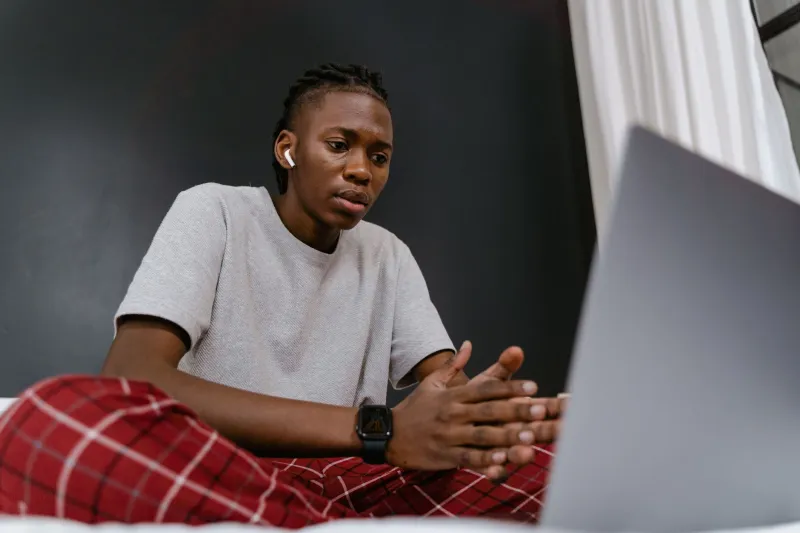
You know the moment. You've just finished a sentence in a virtual Q&A, and then — nothing. Half a second of silence that somehow feels like a full minute. Is the host ignoring you? Did your audio cut out? Did you say something weird? Your brain starts sprinting through every possible explanation while your face does that frozen, slightly-too-attentive thing in front of the camera.
Welcome to one of the most underappreciated psychological landmines of the virtual event era.
The technology delay — even a modest 200 to 400 milliseconds — is enough to throw off the invisible rhythm that human beings use to coordinate conversation. And when that rhythm breaks, our brains don't just notice. They catastrophize.
The Invisible Clock We're All Running On
In person, conversation has a kind of timing that we've spent our entire lives calibrating. We read micro-expressions, body language, breath patterns — all of it happening below conscious awareness. These signals tell us when to jump in, when to hold back, when someone's finished a thought versus just pausing to breathe.
Online, almost all of that gets stripped away. What's left is a flattened, two-dimensional version of human interaction where the only reliable cues are audio and a thumbnail-sized video feed. That's not nothing, but it's a lot less than what our brains evolved to work with.
Researchers who study conversation dynamics have found that delays as short as 1.2 seconds in digital communication start making people perceive the other person as less attentive, less friendly, or less engaged. That's not a glitch in the software — that's a glitch in how human beings interpret silence. We're wired to read gaps as meaningful. And in a virtual setting, gaps are everywhere.
Why Virtual Events Are a Pressure Cooker for Self-Consciousness
There's a particular flavor of anxiety that virtual events tend to produce, and it's different from the garden-variety nervousness of, say, speaking in a conference room. Part of what makes it so intense is the self-monitoring loop.
When you're on camera, you can often see yourself. That little thumbnail of your own face is doing something quietly destabilizing: it's turning you into your own audience. Studies on video-based communication consistently show that people who can see themselves on screen report higher levels of fatigue and self-consciousness than those who can't. You're not just trying to express a thought — you're watching yourself try to express a thought, in real time, while also watching the host, reading the chat, and wondering if your lighting makes you look tired.
That's a lot of cognitive bandwidth devoted to performance anxiety rather than, you know, actually participating.
Add the lag on top of that, and every conversational beat becomes a small test. Did I wait long enough? Too long? Why isn't anyone responding? The silence that would feel totally normal in a physical room — just a beat between thoughts — gets amplified on screen into something that feels loaded with meaning.
The Specific Pain of the Interrupted Sentence
Ask anyone who's done a lot of virtual events and they'll tell you: the accidental interruption is its own special kind of awful. Two people start talking at the same time, both immediately stop, then both start again simultaneously, then there's a weird standoff of "no, you go ahead" performed at each other through a screen.
In person, this kind of thing gets smoothed over in about half a second with a laugh or a gesture. Online, it turns into a five-act drama. And because there's no shared physical space to use as a reference point, figuring out who actually has the floor becomes genuinely confusing.
What's interesting is that this experience hits differently depending on the person. For folks who already feel some social anxiety in conversation, virtual environments can make that anxiety sharper and harder to shake. For more extroverted communicators who rely on reading a room and building energy off an audience, the flatness of the digital format feels like trying to dance in wet cement.
What Event Designers Can Actually Do About It
Here's where it gets useful. Because while you can't eliminate latency (yet), you absolutely can design virtual events that work with human psychology rather than against it.
Build in permission for the pause. Hosts who explicitly normalize silence — who say something like "take a second, there's no rush" before opening up Q&A — give attendees psychological cover to gather their thoughts without feeling like they're failing some invisible speed test. It sounds small. It isn't.
Reduce the self-monitoring load. Some platforms and event formats are experimenting with turning off self-view by default, or at least making it easy for attendees to do so. Less time watching yourself means more mental energy for actually engaging with what's happening in the event.
Design for asynchronous contribution. Not every interaction needs to happen in real time. Breakout discussions, polls, shared documents, and chat threads give people the chance to contribute at their own pace — which is genuinely more comfortable for a huge chunk of the population. Introverts aren't broken; they just process differently, and good event design accounts for that.
Train your hosts in conversational pacing. A skilled virtual host learns to hold silence a beat longer than feels natural before calling on someone, because what feels natural in person is too fast online. They also learn to verbally cue transitions — "I'm going to pause here and let people respond" — so attendees know what's coming and aren't left guessing.
Keep groups small where real conversation matters. The larger the virtual room, the more the conversational anxiety compounds. If genuine interaction is the goal, smaller breakout formats with clear prompts and defined roles give people a fighting chance to actually connect.
The Bigger Picture
None of this is about technology failing us. It's about technology revealing something that was always true: human conversation is a finely tuned, deeply social act that we've never had to think much about because it mostly just worked. Virtual environments pull back the curtain on all the invisible machinery that makes talking to each other feel easy.
The good news? Once you see the machinery, you can work with it. Event creators who understand the psychology of the lag — who design for the awkward pause instead of pretending it doesn't exist — are building experiences that feel genuinely human even through a screen.
And for the rest of us? Maybe it helps just to know that the anxiety you feel in that half-second silence isn't a personal failing. It's a very normal response to a very strange new way of being together. Your Wi-Fi isn't judging you. Probably.