Why Virtual Networking Feels Like a First Date You Never Agreed To

Photo by Photo by Vitaly Gariev on Unsplash on Unsplash
You've been there. The host announces breakout rooms, your stomach does a little flip, and suddenly you're staring at a stranger's pixelated face trying to remember how human conversation works. Virtual networking has become a staple of online events — from industry conferences to digital mixers — and yet, for most people, it still feels about as natural as shaking hands with a robot.
So what's actually going on? Why does digital mingling feel so much more exhausting and awkward than bumping into someone at a conference happy hour or chatting in a hotel lobby between sessions? Let's break it down.
The Room That Isn't Really a Room
When you walk into a physical networking event, your brain is doing a ton of unconscious work. You're reading body language, picking up on ambient noise, noticing who's laughing with who, and using all of that social data to figure out where to plant yourself. It's overwhelming, sure — but it's also rich with information.
Virtual networking strips most of that away. You get a grid of faces, maybe some names underneath them, and a chat box that nobody's really using. The social cues that help us feel comfortable in a crowd simply don't translate to a Zoom grid. You can't drift toward the person who looks friendly. You can't hover near a group and gradually ease into their conversation. You either get put in a room with someone or you don't.
That lack of organic movement is a big part of why virtual networking feels so forced. Every interaction has to be intentional, and for a lot of people, that level of deliberateness is exhausting before the conversation even starts.
The Webcam Stare-Down Is Weirder Than It Looks
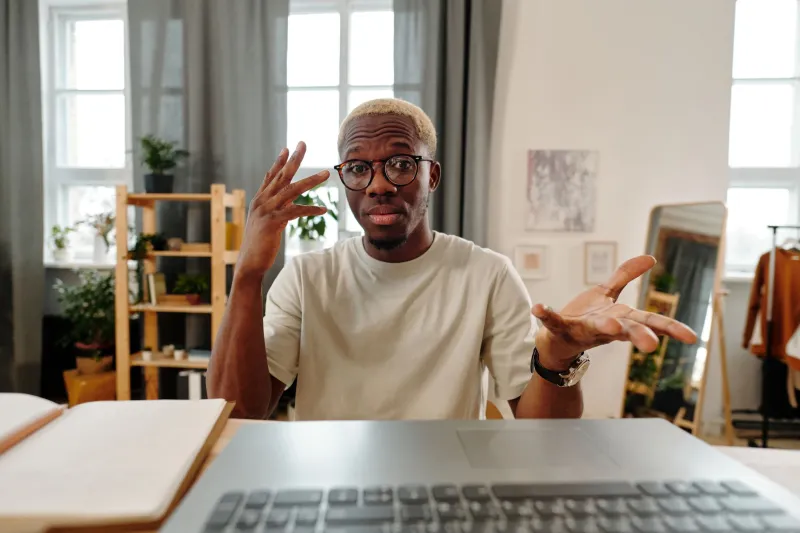
Here's a fun thing nobody tells you: maintaining eye contact on a video call is technically impossible. If you look at someone's eyes on your screen, you're actually looking down from the perspective of your camera. To appear like you're making eye contact, you have to look directly into the lens — which means not looking at the person at all.
That's a deeply strange thing to ask of human beings who have spent their entire lives using eye contact as a tool for connection and trust. The result is this constant low-grade awkwardness where nobody quite feels seen, even when everyone is literally watching each other.
Add to that the self-monitoring effect — that little box in the corner showing your own face — and you've got a recipe for self-consciousness that would make even the most confident networker second-guess themselves. Studies have shown that seeing your own reflection repeatedly makes people more critical of themselves. Virtual calls essentially force you to do that for the entire duration of a conversation.
Small Talk Hits Different on a Screen
In person, small talk has a natural rhythm. You comment on the venue, the food, the speaker you just heard. The environment gives you easy on-ramps into conversation. Online, those shared physical touchstones disappear. You're left with the classic opener — "So, what do you do?" — which, let's be honest, is the conversational equivalent of a firm handshake from a stranger in a parking lot.
The problem isn't that people are bad at small talk. It's that virtual environments strip away the ambient context that makes small talk feel effortless. Without a shared physical space, every conversation starts from zero, and that blank-slate pressure can make even confident people clam up.
There's also a time pressure that doesn't exist at in-person events. Breakout rooms often have countdowns. Structured networking sessions have timers. That ticking clock turns what should be a casual exchange into something that feels weirdly transactional — like you're both trying to pitch each other before the buzzer goes off.
Why It Feels Transactional (Even When You Don't Mean It To)
Virtual networking events often try to solve the awkwardness problem with structure: speed networking, icebreaker prompts, curated matchmaking. And while those tools can help, they can also backfire by making the whole thing feel even more like a business transaction than a human interaction.
When you're handed a prompt card and told to answer it in 60 seconds, you stop being a person and start being a participant. The spontaneity that makes real connection feel meaningful gets replaced by a kind of performance — and most people can sense when they're being performed at rather than genuinely engaged.
Genuine connection tends to happen in the margins: the offhand comment, the shared laugh about something unexpected, the moment where both people drop the professional veneer for a second. Virtual events, with their structured agendas and timed rooms, make it harder for those margin moments to happen.
What Actually Works (And It's Not What You Think)
Here's the good news: virtual networking doesn't have to feel like pulling teeth. A few small shifts can make a real difference.
Go in with one goal, not ten. Instead of trying to collect contacts like Pokémon, aim to have one genuinely interesting conversation. That's it. The pressure drops immediately, and the quality of your interactions goes way up.
Ask weirder questions. "What are you working on that excites you right now?" hits differently than "What do you do?" Give people something unexpected to respond to, and you'll get unexpected — and memorable — answers.
Use the chat box like a human being. Drop a reaction to something the speaker said. Comment on a point someone made. The chat isn't just a placeholder — it's a low-stakes way to signal that you're engaged and open to conversation before a breakout room forces the issue.
Follow up fast and specifically. After the event, send a message that references something specific from your conversation. Not "great to meet you!" but "I've been thinking about what you said about remote team culture — here's a piece I think you'd find interesting." Specificity is what separates a LinkedIn connection from an actual relationship.
Cut yourself some slack. Virtual networking is genuinely harder than in-person networking. If it feels awkward, that's not a personal failing — it's a design flaw in the medium. Knowing that going in takes some of the pressure off.
The Screen Isn't the Enemy
Look, virtual events have opened up access in ways that would have seemed impossible just a few years ago. You can attend a conference in New York from your apartment in Austin. You can connect with people in industries and cities that would never have crossed your path at a local meetup. That's genuinely remarkable.
But connection — real connection — still requires something beyond proximity, digital or otherwise. It requires a little vulnerability, a little curiosity, and the willingness to look past the grid of faces and remember that there's an actual person on the other side of that screen.
The awkwardness of virtual networking isn't going away anytime soon. But it doesn't have to be the whole story.